

James Milner is poised to break the Premier League’s appearance record and former Leeds team-mate Michael Bridges believes his “incredible achievement” is unlikely to be surpassed.
Milner, who turned 40 on January 4, equalled Gareth Barry’s eight-year record of 653 Premier League appearances in Brighton’s defeat at former club Aston Villa on Wednesday night and stands to eclipse it next week at Brentford.
Tony Blair was Prime Minister when Milner made his top-flight debut for hometown club Leeds over 23 years ago and Westlife’s aptly-titled hit Unbreakable was number one in the UK singles chart.
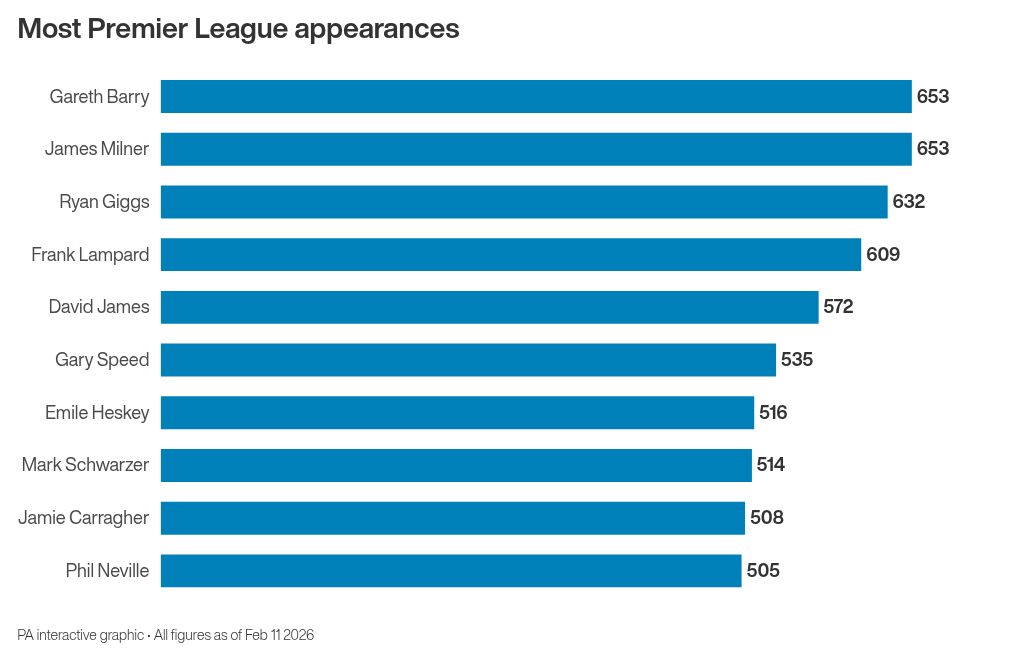
After the Brighton midfielder, the next two active players with most Premier League appearances are Jordan Henderson (454) and Kyle Walker (435), who have some way to go before they reach 500.
Bridges was in the Leeds side which won 4-3 at West Ham in November 2002 when Milner made his first appearance, becoming the Premier League’s second-youngest player at the time aged 16 years and 309 days.
“The way the game’s going I don’t think anyone will get near it,” Bridges told the Press Association. “No, the game’s too quick now and James has gone too far.
“Unless they totally follow what he has done over his career; be as disciplined and professional as him. It takes a hell of a lot of mental toughness, desire and hunger. And also the talent.
The moment @JamesMilner equalled Gareth Barry’s all-time Premier League appearances record! 💫 pic.twitter.com/Hm41gdLID2
— Brighton & Hove Albion (@OfficialBHAFC) February 12, 2026
“There’s only one other player in the world that I can think of, who has also committed his entire life to it, and that’s Cristiano Ronaldo.”
Milner’s career has spanned three decades, including seven years as an England international until 2016. He won 61 caps and also made a record 46 appearances for England Under-21s.
Soon after his top-flight bow for Leeds at Upton Park, Milner broke Wayne Rooney’s record to become the Premier League’s youngest goalscorer at the time, in a 2-1 Boxing Day win at Sunderland.
He still stands second on that list – James Vaughan broke his record in 2005 – and also became the top flight’s second-oldest goalscorer last August, 23 years later, when converting a penalty in Brighton’s 2-1 home win against Manchester City.

Former Sunderland and Leeds forward Bridges, who ended his 20-year playing career in Australia in 2015, was Milner’s room-mate during their time together at Elland Road.
“A senior pro with a youngster, like what Niall Quinn did with me at Sunderland,” Bridges said. “I’m so proud of what Milns has gone on to do. It’s an incredible achievement and his trophy cabinet is not too bad either.”
Milner has won three Premier League titles, the Champions League, two FA Cups and one League Cup and his six top-flight clubs include Leeds, Newcastle, Aston Villa, Manchester City, Liverpool and Brighton.
“Just to keep going for that long in terms of the pre-season,” Bridges said. “There were a lot of pre-seasons towards the back end of my career and with the injuries and all the rest of that, I used to really struggle.
“That’s the hardest part for me. It wasn’t playing during the season, it was actually getting through pre-season and managing the training loads.

“James has been able to do that as he’s progressed through his career because of his personality. The sheer commitment.
“If any young player today wants anybody as an idol or to look up to as a mentor, James Milner is definitely the man.”
Key to Milner’s unrivalled longevity has been his ability to adapt his game and still be good enough for the top flight, Bridges said.
“When James first broke through at Leeds his best attributes were his fitness and his pace,” he said. “He was just like a Duracell bunny, never ran out of energy.
“But he had that ability, when he got on the ball, he was just so calm and relaxed.

“As you go through your career, you see lads who have relied on their pace and when they get hamstring injuries, they retire when they’re like 30 or 31 or they’re not the same players they used to be.
“I look at people like Paul Scholes, Alan Shearer and Teddy Sheringham, intelligent footballers, who were able to adapt their game through the eras that they played.
“We all know we lose our pace, but if you’ve got an intelligent football brain you can adapt to play in different positions and James has got that in abundance.
“He is a bona fide legend of the game.”